
Indonesia’s replanting subsidy is insufficient to empower smallholder farmers to replant aging oil palms
Indonesia has the largest area of oil palm plantations in the world — around 16 million hectares of industrial and smallholder plantations in 2024 — contributing 60% of global palm oil production. The rapid expansion of oil palm during the 1990s and early 2000s, however, has left a growing share of plantations past their productive prime. Today, around 2.4 million hectares of smallholder oil palm are older than 25 years. Based on the oil palm yield curve, replanting at 25 years maximizes long-run productivity at the landscape level. To accelerate replanting, the Indonesian government launched a subsidy program in 2016, most recently doubling it to 60 million rupiah (~$3,631) per hectare in 2024. However, as of 2026, only 384,000 hectares of smallholder plantations received the replanting subsidies.
Our new research, published in npj Sustainable Agriculture, examines why the subsidy has not accelerated smallholder replanting, and what barriers prevent farmers from accessing it. We evaluate the long-run economic impacts of different replanting strategies using scenario analysis. We found that smallholder farmers often delay replanting because it provides greater economic stability and comparable long-term returns in the absence of access to replanting subsidies and certified seedlings. While subsidies can improve long-term profitability (by 30% when replanting at age 25), the 7–8 year income recovery period remains a major deterrent. Without support, that gap stretches to 8–12 years. For a smallholder family with little savings, delayed replanting is not irrational — it is economic survival.
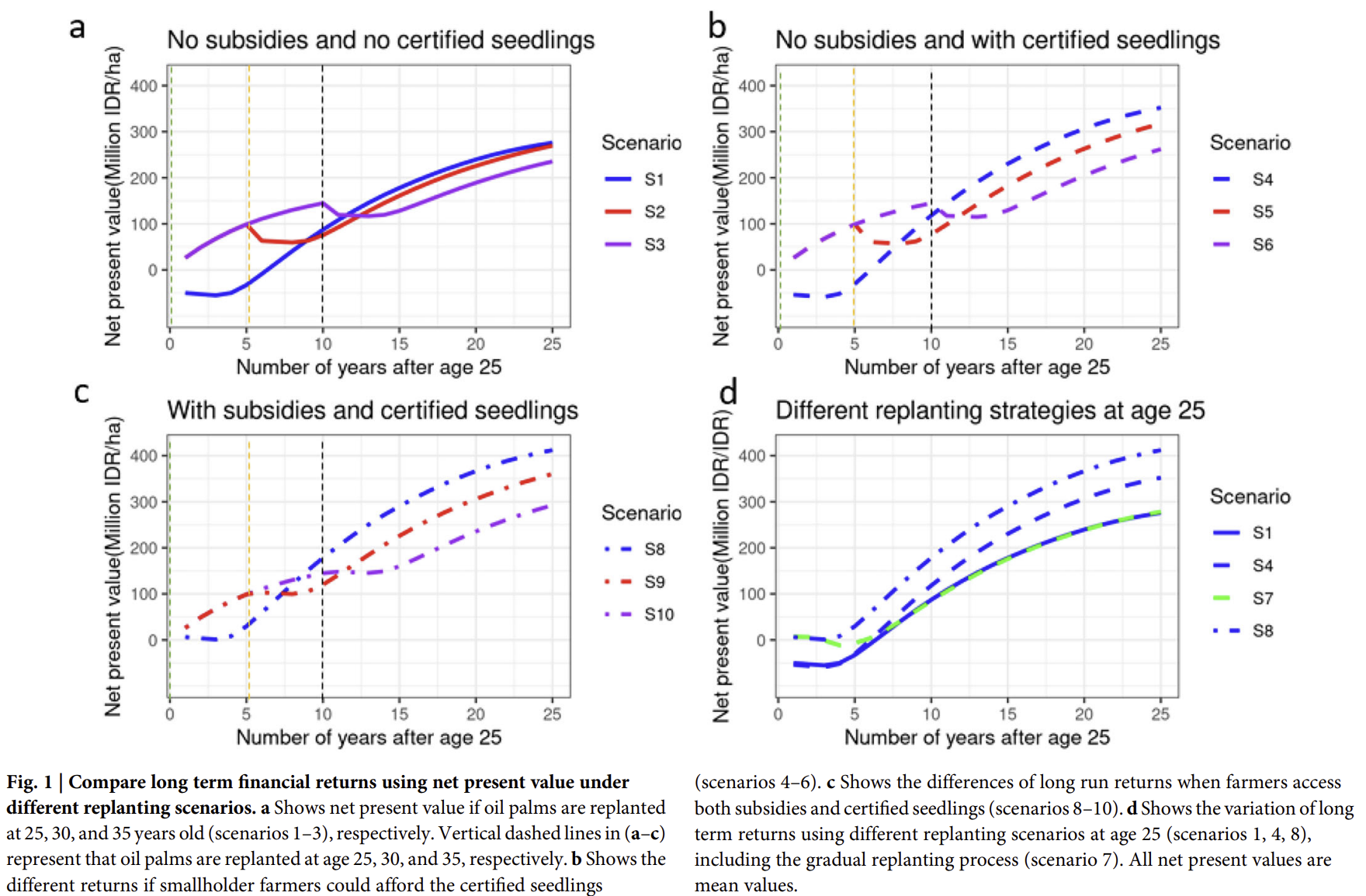
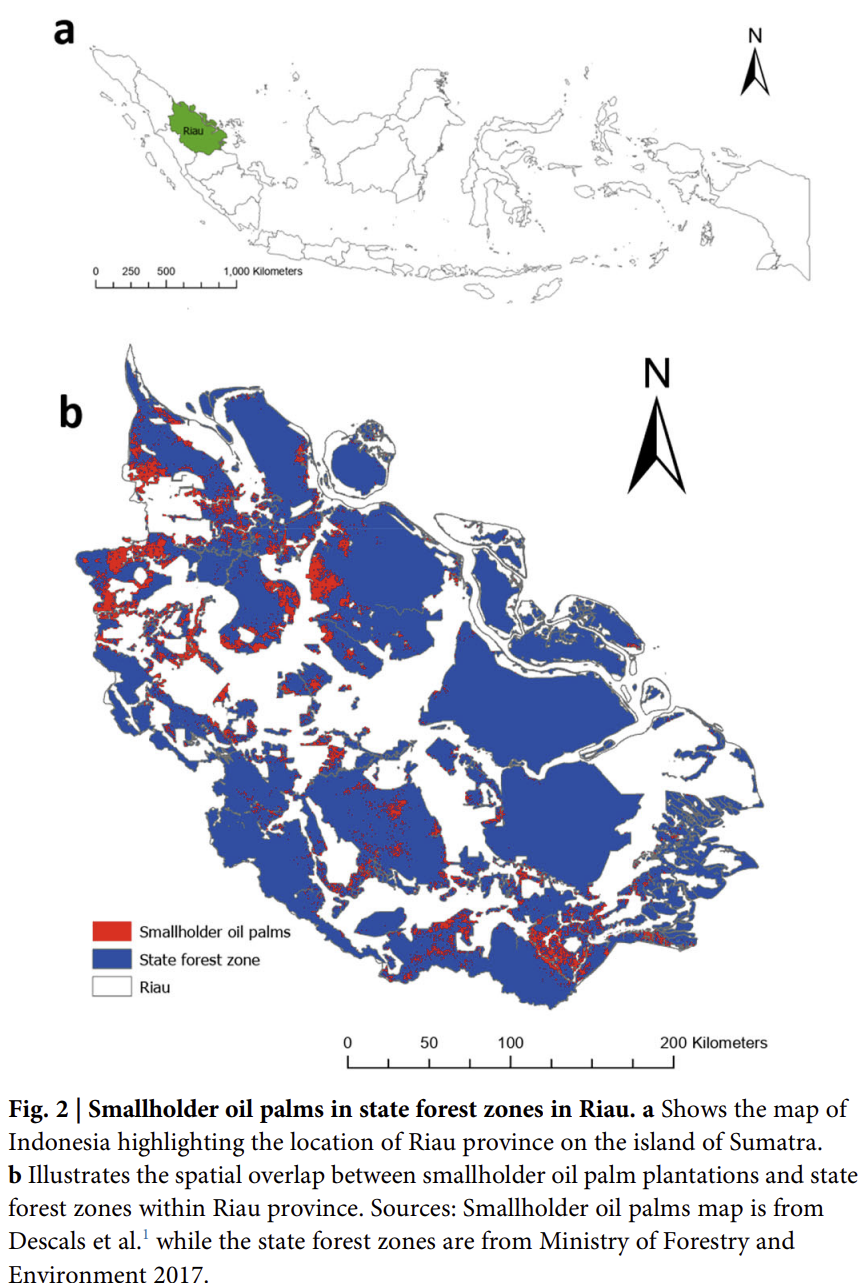
Beyond economics, several structural barriers prevent smallholders from accessing the subsidy. Many farmers lack formal land certificates, which are required for eligibility. The program also requires farmers to belong to a group collectively managing at least 50 hectares. In Riau province alone, 44% of smallholder plantations overlap with state forest zones — making legal land ownership, and therefore subsidy access, impossible without government reclassification of those lands.
Subsidies alone are therefore not enough. They must be paired with income support during the unproductive transition years — through mechanisms such as low-interest loans, mill partnerships, increased market access for intercropping products, or direct income assistance. Resolving the legal barriers around land tenure and streamlining the application process are equally important to unlock replanting across the millions of hectares of aging smallholder oil palm in Indonesia.
Zhao, J., Elmore, A.J., Lee, J.S.H., Numata, I., Zhang, X. and Cochrane, M.A., 2023. Replanting and yield increase strategies for alleviating the potential decline in palm oil production in Indonesia. Agricultural Systems, 210, p.103714.
Zhao, J., Cochrane, M.A., Lee, J.S.H., Zhang, X. and Chalil, D., 2026. Indonesia’s new replanting subsidy is insufficient to empower smallholder farmers to replant aging oil palms. npj Sustainable Agriculture, 4(1), p.32.