
Sun Bears and Oil Palm
When people hear about palm oil, they often immediately think of orangutans, but the conversion of tropical rainforest to oil palm plantations affects many other iconic Southeast Asian species whose stories are less well known to both the general public and scientists. One of these ‘forgotten’ species is the sun bear (Helarctos malayanus). Like all bear species, sun bears need large patches of intact habitat to thrive, so the conversion of primary rainforest to oil palm plantations is a major conservation issue for this species. Sun bears may enter oil palm plantations to search for food, where they are vulnerable to snaring and poaching. Yet despite these risks, we still don’t have a range-wide understanding of how this species will respond to the expansion of oil palm plantations in Southeast Asia.
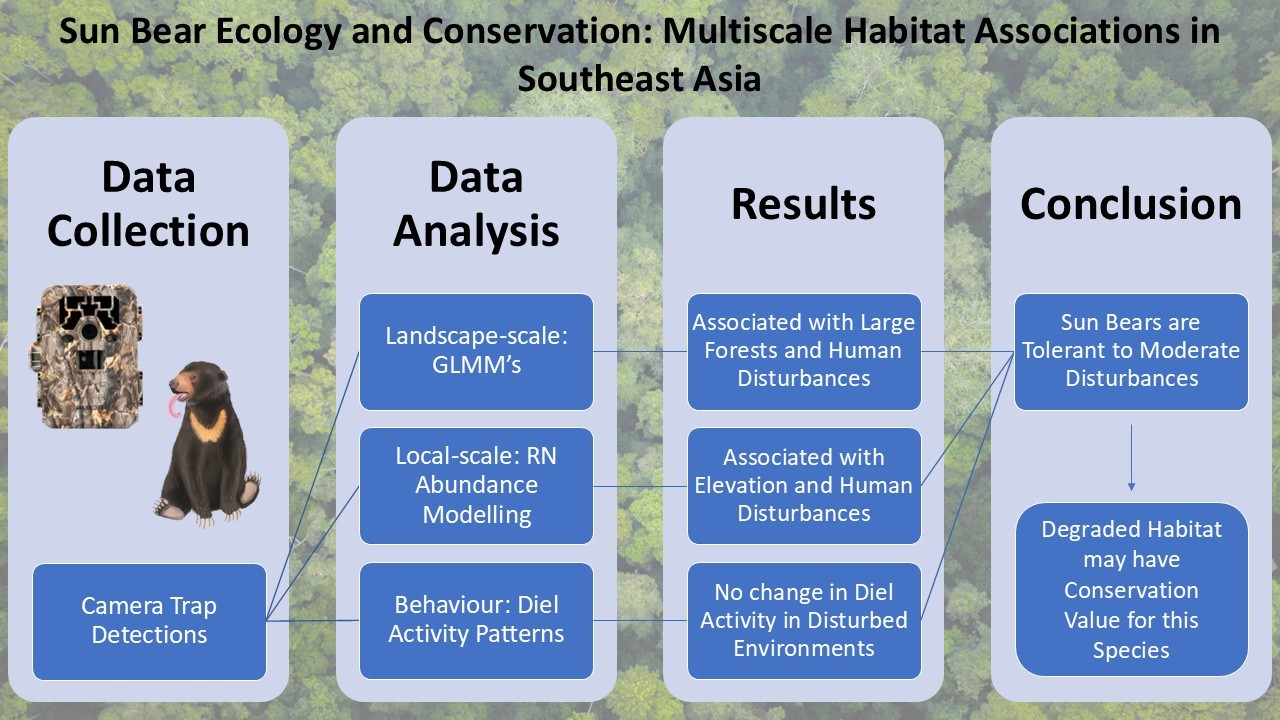
In a recent study published in the journal Integrative Conservation, my colleagues in the Ecological Cascades Lab at the University of Queensland and I examined multiscale habitat association of the sun bear across its range. We compiled camera trap detections of sun bears from both new and previously published studies and assessed how the number of detections changed in relation to habitat covariates such as forest size, human population, and extent of oil palm plantations. We found that sun bears were most regularly detected in large forests, but also in forests that neighbour humans and their infrastructure. These findings support earlier studies that found that sun bears require large intact forests, but also suggest that they are perhaps more resilient than previously realised and can persist in somewhat degraded habitat. A possible explanation for this adaptability is the sun bear’s dietary flexibility and its ability to shift to an insectivorous diet in degraded habitat.
[Photo credit: © 2026 The Author(s). Integrative Conservation published by John Wiley & Sons Australia, Ltd on behalf of Xishuangbanna Tropical Botanical Garden (XTBG).]
In regards to oil palm, we found that sun bear abundance decreased as the extent of oil palm in a landscape increased. Although sun bears may gain some benefit from feeding in oil palm plantations, they still require intact forest to retreat to, and the benefits of foraging in plantations are likely outweighed by the risks of snaring and poaching. Therefore, for sun bears and sustainable palm oil plantations to coexist in Southeast Asia it is essential that as much intact forest is conserved as possible and that semi-degraded areas are also protected, as these regions can still have conservation value for sun bears. We also recommend enforcement of poaching regulations. Finally, we recommend future studies on sun bears focus on their diet, to assess both their use of oil palm plantations for foraging and the hypothesis that dietary flexibility is the key to their adaptability. The sun bear’s plight may not be as visible as that of the orangutan, but with protection of key habitat and further research we can ensure the continued existence of this species and many others into the future.
Find out more: https://onlinelibrary.wiley.com/doi/10.1002/inc3.70071